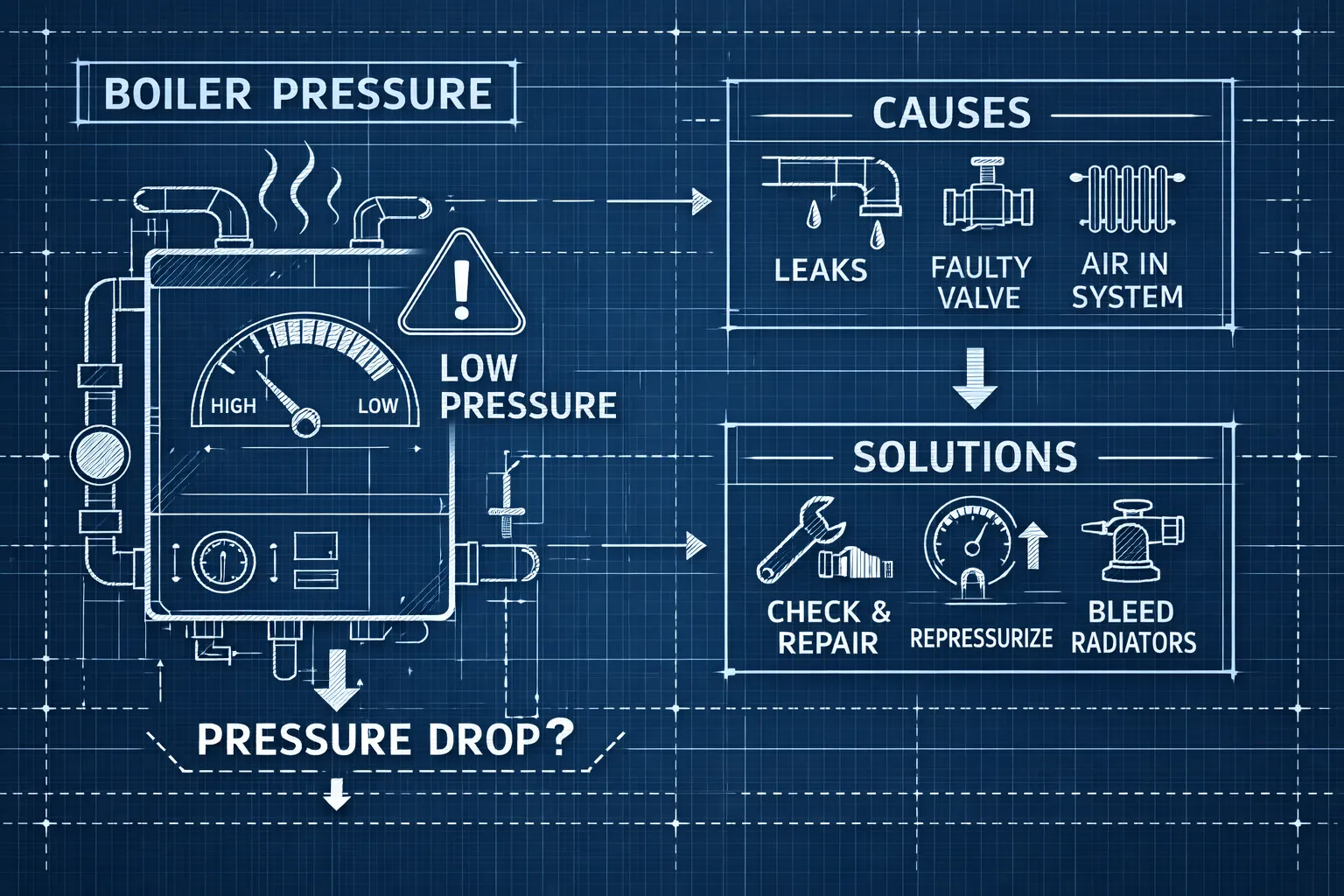
When your radiators go cold or the gauge reads low, knowing why boiler pressure drops helps you decide what to do next. Key checks, a safety checklist, and straightforward troubleshooting explain when a simple top-up is enough and when you may have a pressure relief valve (PRV) leak or a failed expansion vessel. It also explains common causes, why combi boilers often lose pressure faster, and what to do if pressure keeps falling overnight.
Put safety first. Turn the boiler off, isolate electrical power, and leave the system to cool before touching pipes or valves to avoid scalding or damage. If you smell gas, leave the property and call the gas emergency number immediately and do not operate switches or the boiler. When the system is cold, repressurising using the filling loop is straightforward: open the valves slowly, aim for about 1.2 bar (usually between 1.0 and 1.5 bar), then close and monitor for creeping pressure or drips.
What you need to know
Check the pressure gauge. Note the cold pressure and take a photo so you can show it to an engineer if the issue returns. Look for visible leaks, rust, or salt staining and record when pressure drops, particularly after you’ve bled radiators.
Likely causes. Small hidden leaks, a PRV discharging, or a failing expansion vessel are common reasons for pressure loss. Combi boilers often show faster drops because the whole system uses a single heat exchanger and holds less water than larger systems.
Call a Gas Safe engineer. If pressure stays below 1 bar, falls again after topping up, you find visible leaks, or you smell gas, arrange a professional inspection. An engineer can test the PRV, check the expansion vessel and locate concealed leaks safely.
First things to check when pressure drops
Start with the basics. If your boiler is losing pressure, switch it off at the controls and isolate electrical power at the fuse or fused spur, then allow the system to cool. Avoid touching valves or piping until the system is cold to reduce the risk of scalding or causing further damage.
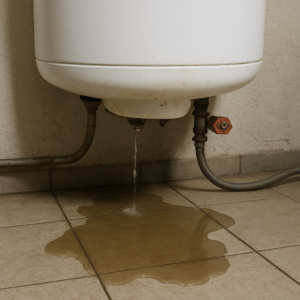
Check for the smell of gas before doing anything else; if you smell gas, leave immediately and call the gas emergency line. If there is no gas smell, note the pressure reading and take a photo to share with an engineer. Visible leaks, pooling water, or steady discharge from an external PRV pipe usually indicate a system leak or a failing PRV rather than a simple top-up need.
Repressurising is a straightforward DIY task when the system is cold and you follow the correct steps. Before topping up, bleed any radiators that need it so you are not replacing water you have just released. Below are step-by-step instructions for both external and internal filling loops. For a short practical guide on repressurising a combi boiler, see how do I repressurise my combi boiler.
- Confirm the boiler is switched off and cold, then locate the filling loop. External loops are braided hoses with two isolation valves, while internal loops are small taps or a built-in valve inside the boiler casing. Make sure any external loop is intact and the valves are closed before you start.
- If using an external loop, attach it correctly if it has been removed and slowly open the two isolation valves so water can flow into the system. For boilers with internal taps, open them slowly in the same way and listen for water entering the system; avoid rushing the process.
- Keep an eye on the pressure gauge and stop when the cold pressure reads between 1.0 and 1.5 bar, aiming for about 1.2 bar on most combi boilers. Do not over-pressurise the system; small increases can cause components to discharge or trigger fault codes.
- Close both isolation valves securely, remove any external loop if required, and return the boiler to normal operation. Run the heating briefly and watch for drips, error lights, or pressure changes during the first cycle. If pressure creeps up or down, or error codes return, isolate the boiler and call a Gas Safe engineer.
Do not keep topping up repeatedly without finding the cause; repeated pressure loss usually means a leak, PRV fault, or expansion vessel issue. If pressure falls again or drops overnight, book a Gas Safe engineer to diagnose and repair the system safely.
Why boiler pressure drops: most common causes
Hidden leaks are the most common reason a sealed system loses pressure. Small steady losses can take days to show and often occur where pipework or fittings are out of sight. Spotting these early avoids repeated topping up and unexpected breakdowns. For detailed advice on finding and fixing leaks, see Causes and Solutions for Boiler Water Leaks.
Radiator valves and bleed nipples are frequent leak points because corrosion or loose valve tails let water weep slowly. Check around valve stems and the underside of radiators for damp, rust, or white salt deposits. A tiny trickle here can remove enough water overnight to make the pressure fall noticeably.
Pipe joints, especially underfloor or concealed runs, can hide hairline splits or corroded fittings under screed or behind plaster. These leaks often show as damp patches on floors or unexpected warm areas and usually need trace detection or thermal imaging to locate. If you suspect concealed piping, contact an engineer rather than chasing the leak yourself.
Internal boiler faults, such as a leaking heat exchanger or failing internal joints, may give few external clues but cause steady pressure loss. Signs include water inside the casing, persistent error codes, or the boiler locking out. Internal repairs must be carried out by a Gas Safe engineer because they involve sealed components and gas systems.
Condensate runs and appliance connections can leak at plastic joints or where they discharge outside, leaving salt staining on walls or paving. Small drips from plastic pipework are easy to miss but add up over time. Check visible runs for damp or crusty deposits to rule them out before arranging more invasive checks.
If there is no obvious leak, mechanical faults are likely: a PRV discharging or an expansion vessel that has lost its air charge. A sticking PRV shows as a constant damp or drip at the external discharge pipe, while a failing expansion vessel typically causes pressure to rise when hot and fall when cold. Both issues need a Gas Safe engineer to test pressures and replace components safely. For a general explainer on why boilers lose pressure, see why does my boiler keep losing pressure.
Troubleshooting by boiler type and timing clues
Combi boilers handle heating and hot water from a single unit, so their symptoms often narrow the cause more quickly than larger systems. Because the system holds less water, a small loss shows up faster and you may notice pressure drops overnight. Note whether hot water, central heating, or both are affected to help target the fault.
Quick visual checks save time: inspect the discharge pipe for drips, scan radiator valves for corrosion, and listen for gurgling or air noises when the system starts. Frequent radiator bleeding after topping up suggests a leak or air ingress rather than a one-off top-up issue. Recording when the pressure falls — after heating, overnight, or after bleeding radiators — helps an engineer focus their tests.
System and conventional boilers use separate cylinders and may have an open-vent cistern or separate feed and expansion components, so faults appear differently. On open-vent systems, a failed cistern float or feed valve can let water return to the cistern and reduce loop pressure, often visible as a damp or overflowing loft cistern. Sealed systems narrow the likely causes to a PRV or expansion vessel problem if pressure only drops after a heating cycle.
Keep a simple log of when pressure falls and any recent work or radiator bleeding; timing clues are often the quickest way to narrow the cause. If pressure drops only after the system cools, suspect an expansion vessel or pressure relief path; if it falls while running, look for an active leak. Share your notes with the engineer to speed diagnosis and avoid unnecessary part replacements.
DIY tests and simple diagnostics you can do
Start by testing the PRV with the system cold: lift the test lever briefly to check for a short flow and confirm it reseats. Watch the external discharge pipe for continuous drips — steady running after a short lift means the valve is not sealing and must be replaced. Do not force the valve or keep lifting it if heavy flow, steam, or severe corrosion appears; isolate the boiler and call an engineer instead.
You can do a non-destructive check of the expansion vessel at home. Tap the vessel: a hollow sound at the top and a duller thud at the bottom usually indicates the air cushion is present, while a uniform dull sound suggests the vessel has lost its charge. If the vessel has a Schrader valve you can check the pre-charge with a tyre gauge, but do not add air unless you know the correct pressure and can isolate the system.
Before arranging costly work, try low-cost leak-finding and isolation checks to narrow the fault. A soap solution on joints can reveal tiny leaks, and running your hand along concealed pipe runs may find warm spots that reveal a leak. To check whether the boiler itself is losing water, close the inlet and outlet isolation valves and see if the boiler holds pressure; if it does, the issue is likely in the heating loop rather than inside the boiler.
When to call an engineer and what to expect
Certain signs mean you should stop DIY and call a Gas Safe engineer right away because the fault could cause water damage or create safety risks. These include continuous discharge from a PRV, repeated daily top-ups, water inside the boiler casing, persistent error codes, or any smell of gas. Arrange a professional inspection without delay if you see any of these warnings.
On a visit an engineer will perform a pressure test, inspect the PRV and expansion vessel, and trace any hidden leaks. Minor repairs like replacing a PRV or sealing a small leak typically cost around £100 to £300, while replacing an expansion vessel is often £400 to £750 depending on access and parts. For a practical cost guide for boiler repairs see boiler repair cost. Heat exchanger repairs or full boiler replacements are more expensive; your engineer will explain options and provide a written quote before any work begins. If you need a replacement, speak to a local specialist about Boiler Installation In Reading, Plumbers 24hrs Ltd.
Gas Boiler Servicing in Reading, Plumbers 24hrs Ltd provides same-day emergency visits across Reading and all of Berkshire and is Gas Safe registered and Worcester Bosch accredited. Engineers quote upfront, carry diagnostic tools, and work to restore safe operation with transparent pricing and no call-out fee. To arrange a pressure check or request an emergency visit, contact Plumbers 24hrs Ltd and tell the team the boiler make and model plus any recent pressure readings or visible signs.
Why boiler pressure drops: what to do next
Boiler pressure most often falls because of small leaks, loss of system water after bleeding, or a failing expansion vessel. If you smell gas, leave immediately and call the gas emergency number; do not operate the boiler. If there is no gas smell, scan for damp patches, rust staining, salt deposits, or a radiator you keep bleeding and note the pressure on the gauge.
Read your boiler manual and follow the manufacturer’s procedure to top up the system if you are confident doing so, aiming for a cold pressure around 1.2 bar. For manufacturer guidance on repressurising a combi, see how to repressurise a combi boiler. If the gauge is below 1 bar, pressure falls again after topping up, you see leaks, or you smell gas, switch the boiler off, ventilate the area, and contact a Gas Safe engineer. Acting promptly prevents small faults from becoming costly repairs and keeps occupants safe and warm.